Panic Bars and Exit Devices in Ventura County
Code-compliant panic bars and exit devices for commercial properties across Ventura County. We stock Von Duprin, Sargent, Yale, and Adams Rite hardware and handle installation, repair, and replacement. Every job includes a code compliance check at no extra charge. Call (805) 765-3717 for same-day service.
 Call (805) 765-3717
 Text for Quote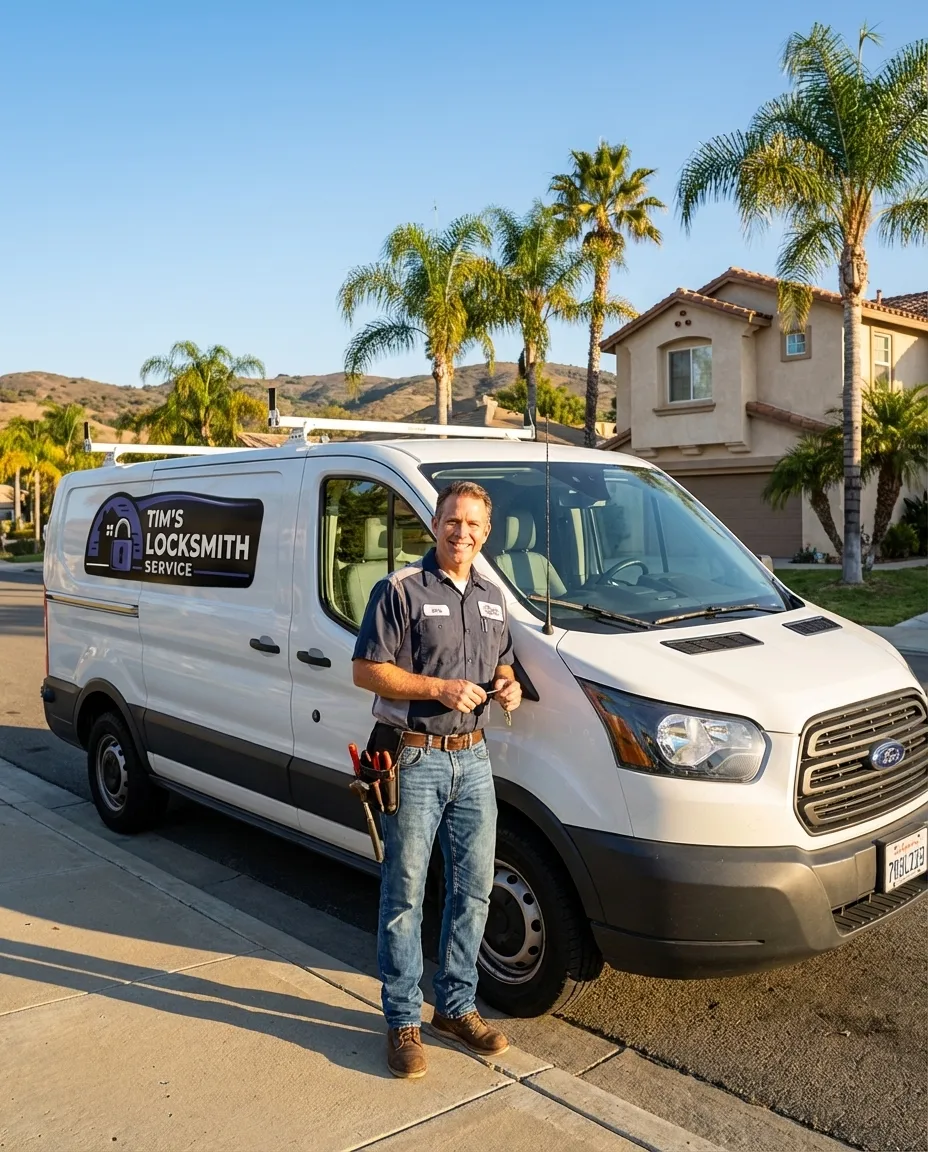
Professional Panic Bar Installation and Repair
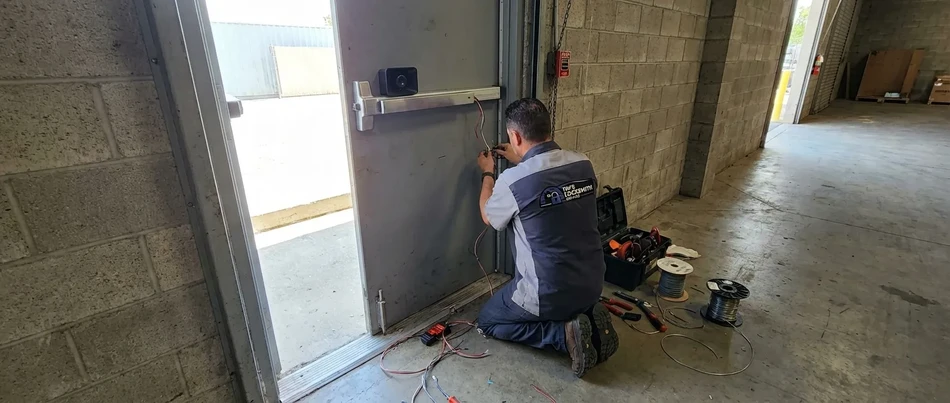
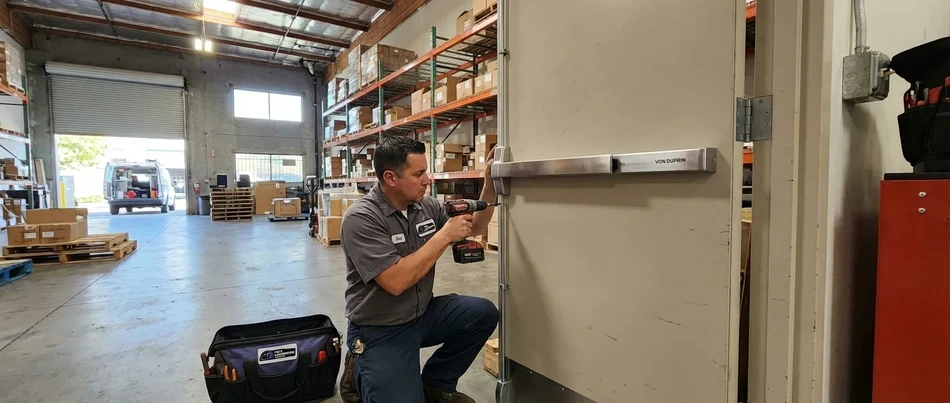
We carry panic hardware from Von Duprin, Sargent, Yale, and Adams Rite in our mobile unit. Rim-type exit devices, vertical rod assemblies, concealed rod hardware, alarmed exit devices, and delayed egress systems, we install and service all of them.
Every panic bar job includes a California Fire Code and ADA compliance check at no extra charge. If your hardware does not meet current code, we identify the gaps and fix them on the spot.
What's Included
Every panic bars and exit devices visit in Ventura County covers code compliance assessment of all exit doors, panic bar installation, and strike and frame preparation; the full checklist is below.
 Code compliance assessment of all exit doors
- Panic bar installation, repair, or replacement
- Strike and frame preparation
- Door closer coordination
- ADA verification
- Fire alarm integration (where applicable)
- Post-install testing of all exit hardware
How It Works
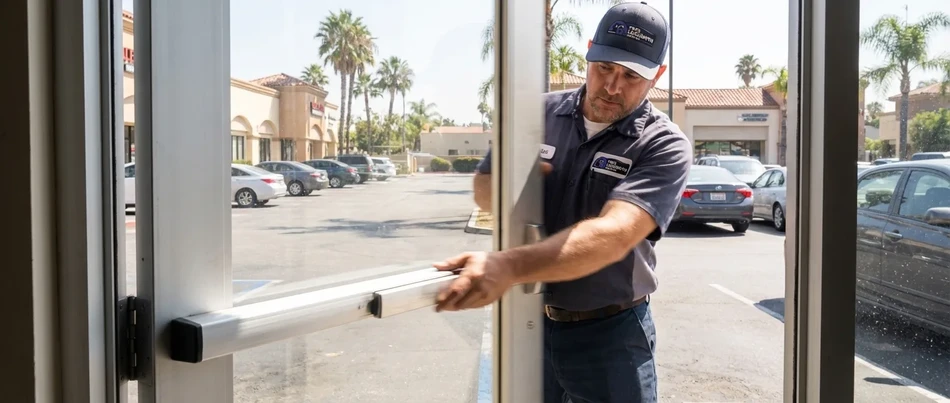
Getting panic bars and exit devices done in Ventura County takes three steps: call or text us, we come to you, and code-compliant install.

Call or Text Us
Reach out at (805) 765-3717 by phone or text. Describe the door, the problem, and we will give you an upfront quote. If you are not sure what you need, we will come assess it for free.

We Come to You
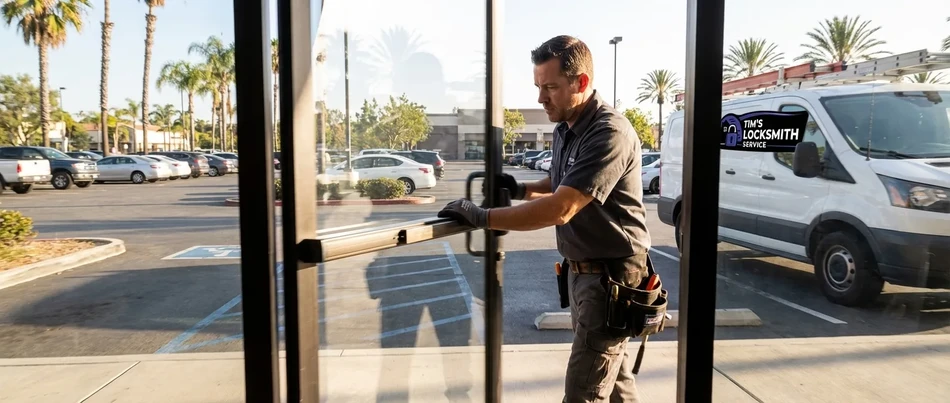
Our mobile van arrives at your commercial property anywhere in Ventura County with panic hardware, tools, and the parts needed for most common repairs and installations.

Code-Compliant Install
We install or repair the panic hardware, coordinate with door closers and strikes, verify ADA compliance, and test everything before we leave. You get a working, code-compliant exit door.
Types of Panic Bars and Exit Devices
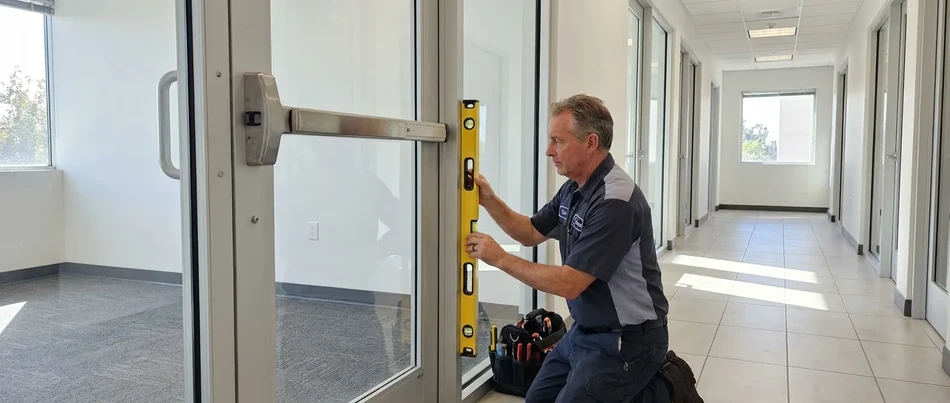
Work on panic bars and exit devices in Ventura County usually falls into a few categories, including rim-type exit device, vertical rod exit device, and concealed vertical rod exit device.
-
 Rim-Type Exit Device
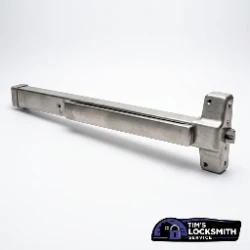
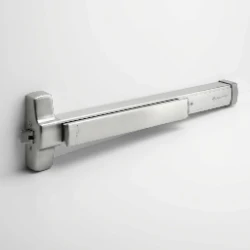
The most common panic bar type. A rim-type exit device mounts on the interior surface of the door with a latch that engages a strike on the frame. When the push bar is depressed, the latch retracts and the door opens. Rim-type devices are used on single doors, pairs of doors, and doors with closers. They are the most affordable option and the easiest to install and maintain. Most commercial buildings in Ventura County have at least one rim-type exit device on a rear or side exit door.
Common issues: latch not fully retracting, worn springs causing weak bar return, and corrosion on the strike plate and latch bolt, especially on doors exposed to coastal air in Oxnard, Ventura, and Port Hueneme.
-
 Vertical Rod Exit Device
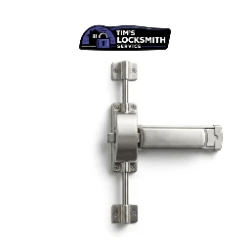
Vertical rod panic bars use rods that extend from the push bar up to the top of the door and down to the bottom. Latches at the top and bottom of the door engage strikes in the header and threshold. Vertical rod devices are used on double doors without a center mullion and on fire-rated openings where top and bottom latching is required by code. They provide stronger hold than rim-type devices because the door is secured at three points instead of one.
Common issues: rod binding due to door sag or misalignment, top latch not engaging the header strike, and bottom bolt dragging on the threshold. Vertical rod devices require more precise alignment than rim-type and are more sensitive to door and frame movement over time.
-
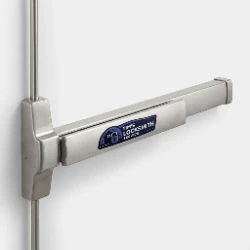
 Concealed Vertical Rod Exit Device
Concealed vertical rod devices work the same way as surface vertical rod devices, but the rods and latches are hidden inside the door. The push bar is the only visible hardware. These are used on pairs of doors in finished spaces where aesthetics matter, office lobbies, retail storefronts, and hotel corridors. Concealed rod devices require a specific door prep (top and bottom mortise pockets) and are more expensive to install and repair because accessing the internal components means pulling the door.
Common issues: internal rod disconnection, top or bottom latch failure that cannot be seen from outside the door, and difficulty diagnosing problems because all moving parts are hidden. Concealed rod repairs take longer and cost more than surface rod repairs because of the access requirements.
-
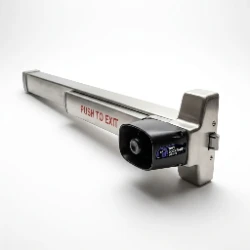
 Alarmed Exit Device
Alarmed exit devices combine a standard panic bar with a built-in alarm that sounds when the door is opened. They are used on emergency exits that should only be opened in an emergency, warehouse side doors, stockroom exits, and back doors in retail. The alarm is typically a loud horn (90-100 dB) powered by a 9-volt battery or hardwired to the building alarm system. Alarmed exit devices deter unauthorized use of emergency exits while maintaining code-compliant free egress.
Common issues: dead batteries causing alarm failure, false alarms from loose wiring or bad sensors, and employees propping the door open which drains the battery and defeats the purpose of the alarm.
-
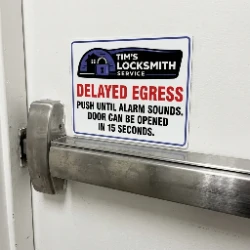
 Delayed Egress Device
Delayed egress devices hold the door locked for a set period (typically 15 or 30 seconds) after the push bar is activated, then release automatically. During the delay, an alarm sounds and a sign illuminates instructing the person to wait. Delayed egress is permitted by code in specific situations, typically in healthcare facilities, memory care units, and retail stores where theft prevention is a concern. The device must release immediately when the fire alarm activates. Delayed egress installations in Ventura County require coordination with the fire alarm panel and must meet California Building Code Section 1010.1.9.9.
Common issues: integration failures with the fire alarm panel (the door does not release when the alarm triggers), timer malfunctions, and wiring problems between the device and the building fire alarm system. Delayed egress devices require periodic testing to verify fire alarm integration is working correctly.
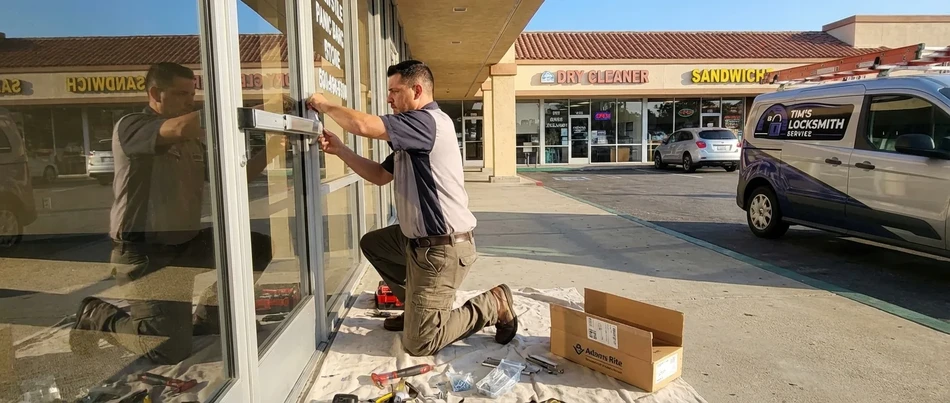
California Fire Code and ADA Compliance
Panic hardware is not optional on most commercial exit doors. California Fire Code, California Building Code, and ADA all have specific requirements for exit devices on commercial properties. Here is what applies to buildings in Ventura County.
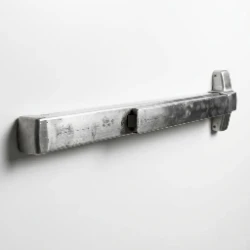
 When Panic Hardware Is Required by Code
- Any exit door serving an occupant load of 50 or more (California Building Code Section 1010.1.10)
- All doors in the path of egress from Assembly (A), Educational (E), and High Hazard (H) occupancies
- Fire-rated doors in exit enclosures and exit passageways
- Doors serving spaces where occupants may not be familiar with the exit (retail, restaurants, event venues)
The egress path is not just the final exit door. Every door between the occupied space and the public way that serves the required occupant load must have panic hardware. We assess the full egress path, not just the door you called about.
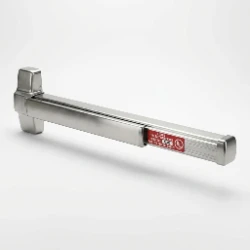
 Panic Hardware vs. Fire Exit Hardware
These are not the same thing. Panic hardware (UL 305 listed) is for non-fire-rated doors. Fire exit hardware (UL 10C listed) is for fire-rated doors. If a fire-rated door has a panic bar that is only UL 305 listed, it does not meet code. The device must be UL 10C listed for the fire rating of the door assembly. We verify the listing label on every device we install or service and make sure it matches the door rating. Installing the wrong type can void the fire rating of the entire door assembly.
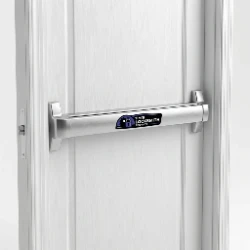
 ADA Requirements
- Operating force must not exceed 15 pounds to release the latch (California Building Code Chapter 11B)
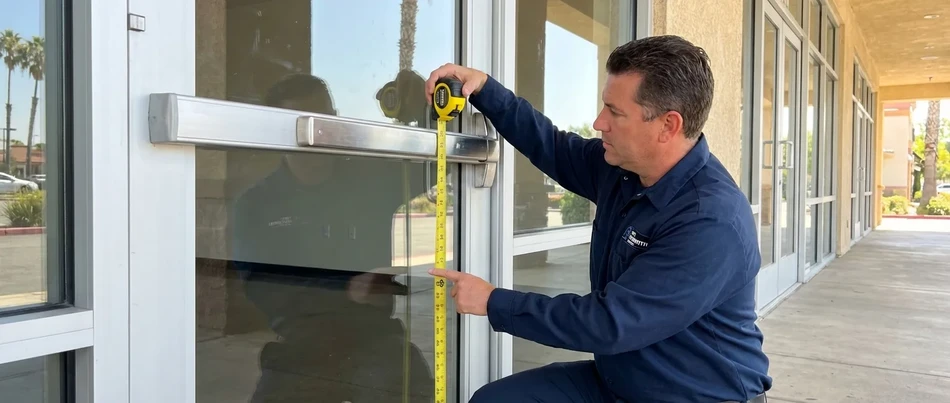
- The push bar must be mounted between 34 and 48 inches above the finished floor
- The push bar must extend at least half the width of the door leaf
- The door closer must allow the door to swing from full open to the latch position in at least 5 seconds
- No tight grasping, pinching, or twisting of the wrist is permitted to operate the device
- Hardware must be operable with one hand without tight grasping
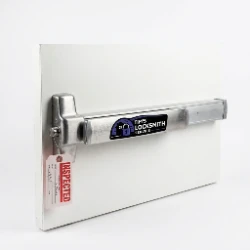
 What Fire Marshals Check
- UL listing labels on every exit device match the door fire rating
- All exit devices operate with a single push motion
- Delayed egress devices release within 1 second of fire alarm activation
- No locks, chains, or secondary latching that would impede egress
- Exit hardware is maintained in working order with no binding, sticking, or excessive force required
- Dogging mechanisms are not engaged on fire-rated doors (dogging is prohibited on fire exit hardware)
In Ventura County, the fire marshal inspects commercial buildings annually. A failed panic bar or non-compliant exit device can result in a correction notice, fines, or an order to cease operations until the issue is resolved. We see this happen every year to businesses that deferred maintenance on their exit hardware.
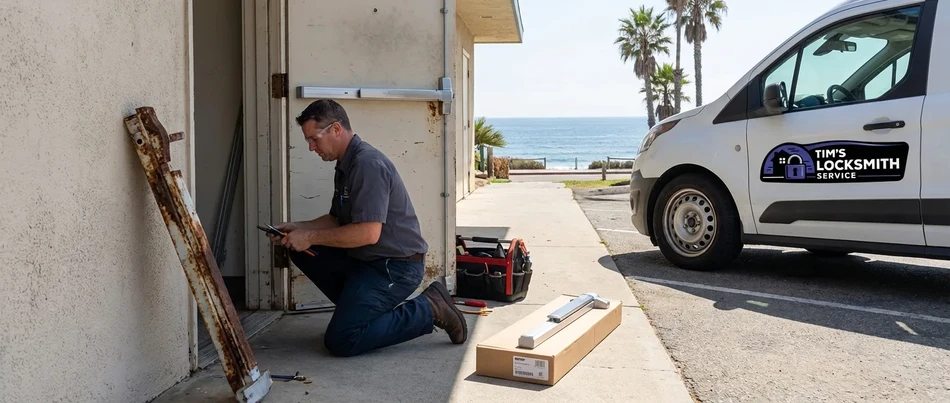
Brands We Install and Service
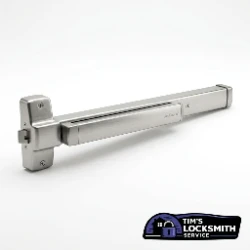
 Von Duprin (Allegion)
The most widely specified panic hardware brand in commercial construction. Von Duprin makes the 98/99 series rim device, the 22 series concealed vertical rod, and the Chexit delayed egress system.
Their hardware is built for high-traffic institutional use and is the standard in schools, hospitals, and government buildings. Parts and service support are the best in the industry. If you are not sure what brand to choose, Von Duprin is the safe bet.
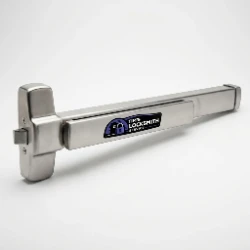
 Sargent (ASSA ABLOY)
Sargent panic hardware is common in office buildings, hotels, and mid-range commercial properties. Their 80 series rim and vertical rod devices offer good performance at a lower price point than Von Duprin. Sargent also makes the FM8700 fire-rated device and the 12-8800 delayed egress system. We carry the most common Sargent replacement parts in our van.
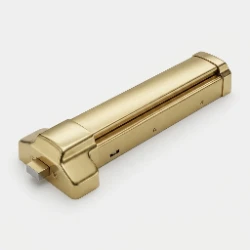
 Yale
Yale
Yale exit devices are found in retail, hospitality, and multi-tenant commercial buildings. Their 7000 series is a reliable mid-range option for standard commercial applications. Yale also offers alarmed exit devices and delayed egress hardware. Yale is part of the ASSA ABLOY family and shares some component compatibility with Sargent.
 Adams Rite
Adams Rite specializes in narrow-stile exit devices for aluminum storefront doors and glass doors. If your building has a glass storefront entry with a panic bar, it is almost certainly Adams Rite hardware. Their 8600 series and the Rite Exit device are the standard for narrow-stile applications. We also service Adams Rite electric strikes and deadlatches that work in conjunction with storefront panic bars.
A note on budget brands: we occasionally see panic bars from Falcon, Precision, and other lower-tier manufacturers. While these brands meet minimum code requirements, they wear out faster, have fewer available replacement parts, and are harder to service. If you are replacing a budget panic bar that failed, we recommend upgrading to Von Duprin or Sargent hardware that will last significantly longer with less maintenance.
Coastal Hardware Guide
Commercial properties near the coast in Ventura County face accelerated hardware failure from salt air exposure. Panic bars and exit devices are particularly vulnerable because they are mounted on exterior doors that face the weather.
 What Coastal Corrosion Does to Panic Hardware
- Latch bolts that pit and no longer retract smoothly
- Push bar surfaces that corrode and become rough or sticky to the touch
- Spring mechanisms that seize from internal salt buildup
- Vertical rod assemblies that bind as corrosion builds on the rod guides
- Strike plates and mounting screws that rust into the frame
 Recommended Materials
- Stainless steel latch bolts and strikes instead of standard plated steel
- Anodized aluminum push bar covers for surface-mount devices
- Silicone-based lubricant on all moving parts every 6 months (not WD-40 or oil-based products)
- Stainless steel mounting screws to replace standard zinc-plated screws
- Sealed rod guides for vertical rod devices to keep salt out of the rod channels
We recommend coastal commercial properties have their exit hardware inspected annually before fire marshal inspection season. Catching corrosion early is the difference between a $150 adjustment and a $500 replacement.
Pro Tips for Panic Bar Owners
 Check the Door Before Blaming the Bar
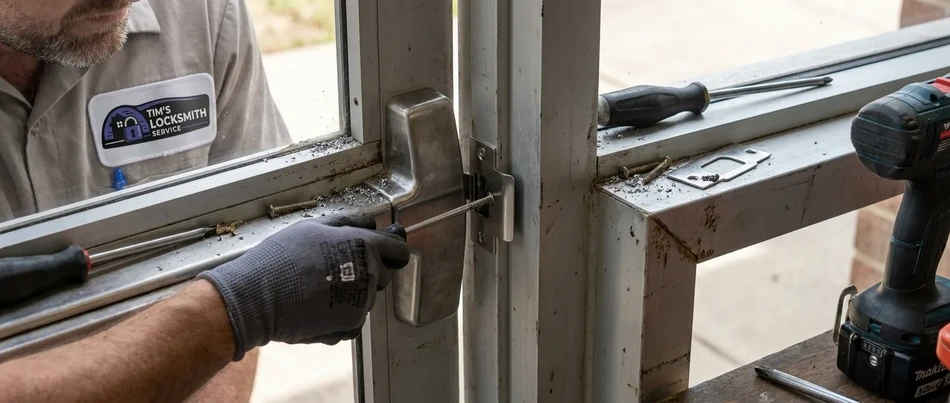
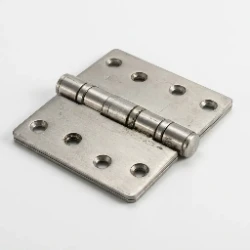
Most panic bar "failures" are actually door problems. A sagging door, loose hinges, or a shifted frame will cause the latch to miss the strike, the vertical rods to bind, or the push bar to feel stiff. Before assuming the panic bar is broken, check the door alignment. If the door has dropped on the hinge side, fixing the hinges will fix the panic bar.
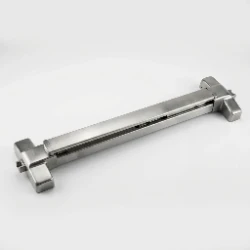
 Two-Stage Push Red Flag
If your panic bar requires two pushes to open, one to retract the latch and another to push the door open, the spring tension is set too high, the latch bolt is dragging, or there is binding in the mechanism. Code requires a single motion to open. A two-stage push means your exit hardware does not meet code, and it will be flagged in a fire inspection.
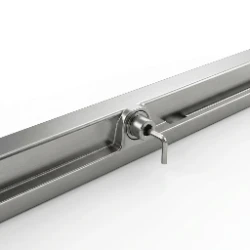
 Dogging Isn't Always Legal
Dogging is the feature that holds the push bar in the depressed position so the door can be pushed open without activating the latch. It is convenient for high-traffic hours, but dogging is prohibited on fire-rated doors because it defeats the positive latching required for fire containment. If your fire-rated exit door has the dogging engaged, disengage it immediately. We can install an electric latch retraction device instead, which achieves the same convenience while maintaining fire compliance.
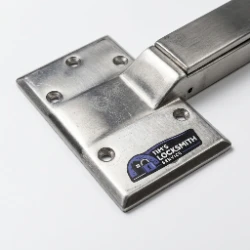
 Match the Brand to the Door
Panic hardware is not universal. Von Duprin, Sargent, Yale, and Adams Rite all have different mounting patterns, strike preparations, and vertical rod configurations. Installing a Von Duprin device on a door prepped for Sargent means drilling new holes, which weakens the door and voids the fire rating on fire-rated assemblies. We always match the replacement brand to the existing door preparation whenever possible.
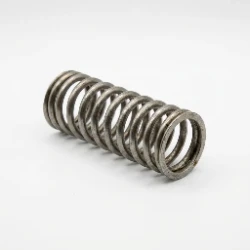
 Spring Fatigue Has a Feel
A healthy panic bar has firm, even resistance across the full stroke of the push bar, and the bar snaps back to the extended position when released. If the bar feels mushy, returns slowly, or does not return at all, the internal spring is fatigued. Spring replacement is a routine repair that costs far less than a full device replacement if you catch it early.
Common Panic Bar Problems
The warning signs we see most often in Ventura County are latch Won't Fully Retract, vertical Rod Binding, and door Won't Latch Closed; each one is explained below.
-
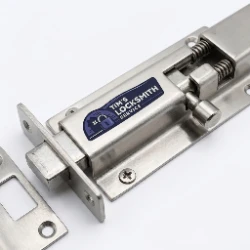
 Latch Won't Fully Retract
The most common panic bar complaint. When the push bar is fully depressed but the latch bolt does not retract completely, the door will not open freely. Causes include a broken or fatigued spring, debris in the latch mechanism, or a misaligned push bar linkage. On rim-type devices, this is usually a 30-minute repair. On concealed rod devices, it takes longer because the door must be removed to access the internal mechanism.
-
 Vertical Rod Binding
Vertical rod panic bars are sensitive to door alignment. When a door sags, warps, or the hinges loosen, the rods bind against their guides and the top or bottom latches fail to engage or retract. The fix involves realigning the door on its hinges, adjusting the rod guides, and verifying that both latches engage and retract smoothly. If the rods are bent from prolonged misalignment, they need to be replaced.
-
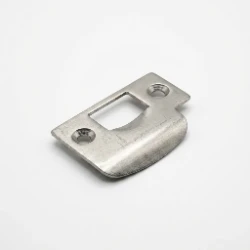
 Door Won't Latch Closed
When the door swings closed but does not latch, the latch bolt is not reaching the strike or the strike pocket is obstructed. Common causes include a shifted frame, a worn or corroded latch bolt that is too short to reach the strike, or a door closer that does not have enough closing force to compress the latch into the strike. We check the gap between door and frame, adjust or replace the strike, and coordinate with the door closer to ensure reliable latching.
-
 Dogging Mechanism Failure
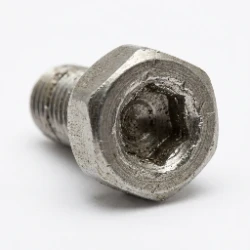
The dogging feature uses a hex key or Allen wrench to hold the push bar in the depressed position. When the dogging screw strips, seizes, or the internal dogging mechanism breaks, the bar either will not dog at all or will not release from the dogged position. Dogging screw replacement is a simple repair if the screw is accessible. If the internal mechanism is broken, the push bar assembly needs to be disassembled.
-
 Corrosion on Exterior Devices
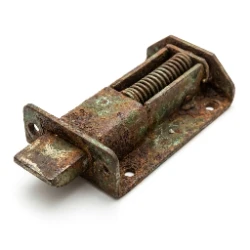
Panic bars on exterior doors, especially in coastal Ventura County areas like Oxnard, Ventura, and Port Hueneme, are exposed to salt air that corrodes the latch bolt, push bar, springs, and mounting hardware. Surface corrosion can be cleaned and lubricated. When corrosion has reached the internal spring mechanism or the latch bolt pivot, the device usually needs replacement because the corroded parts cannot be restored to reliable function.
 When to Repair vs. Replace
 Repair when:
- Spring replacement on a device that is otherwise in good condition
- Latch bolt or strike plate replacement
- Dogging screw or mechanism repair
- Rod adjustment and alignment on vertical rod devices
- Push bar return spring replacement
 Replace when:
- Internal corrosion on coastal installations
- Discontinued devices where replacement parts are no longer available
- Devices that have been repaired multiple times and continue to fail
- Fire-rated devices that no longer carry a valid UL listing label
- Devices that do not meet current code requirements
What Does Panic Bar Service Cost?
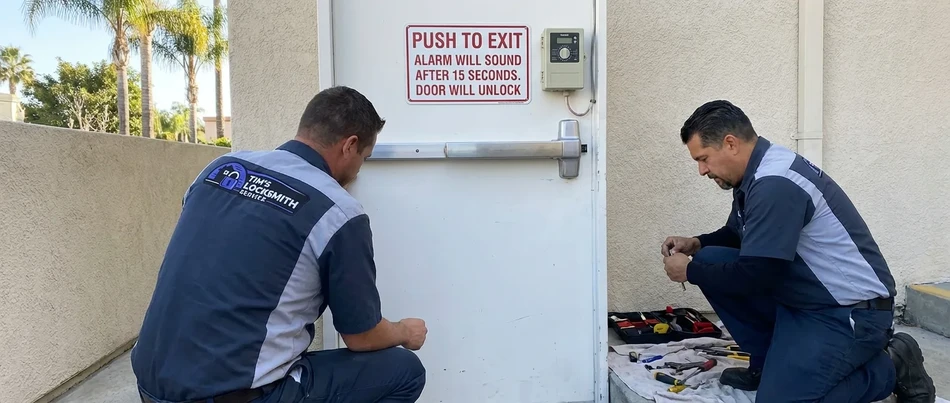
Panic bars and exit devices pricing in Ventura County depends on the hardware, the door count, and how hard the access is; the table below shows typical ranges.
 Rim-Type Exit Device Install
Standard rim-type panic bar installation on a prepped door. Includes the device, strike, and door closer coordination.
 Vertical Rod Exit Device Install
Surface or concealed vertical rod installation. Includes header and threshold strikes, rod adjustment, and alignment.
 Concealed Vertical Rod Install
Concealed rod device installation including door prep, internal rod routing, and concealed hardware alignment.
 Alarmed Exit Device Install
Alarmed panic bar installation with horn, wiring, and alarm testing. Battery or hardwired configurations.
 Delayed Egress Device Install
Delayed egress installation including fire alarm integration, timer setup, signage, and compliance testing.
 Panic Bar Repair or Adjustment
Diagnosis and repair of existing panic hardware. Includes spring replacement, latch adjustment, rod alignment, and dogging repair.
Call (805) 765-3717 for an exact quote
Why Choose Us
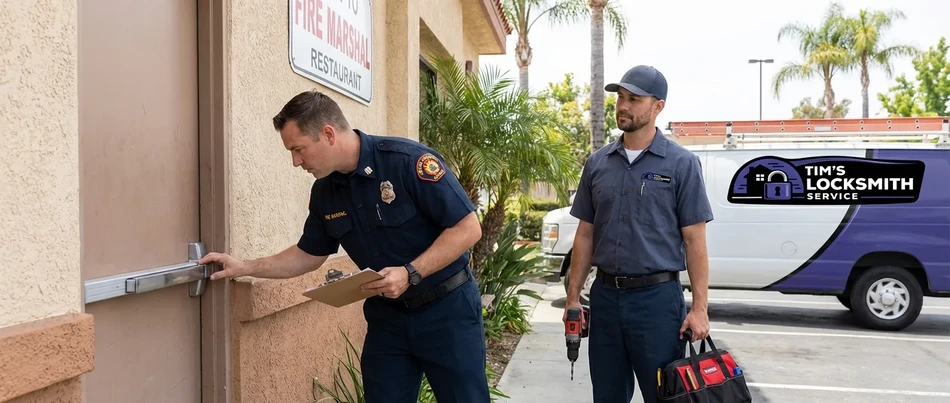
Six reasons Ventura County customers call Tim's for panic bars and exit devices work: Licensed and Insured, Code Compliance Built In, We Know Ventura County, Right Brand for the Job, Same-Day Service, and The Door Gets Checked Too.

Licensed and Insured
California BSIS licensed (LCO#7134) and insured through State Farm. Commercial work requires a licensed locksmith and we carry the credentials to prove it.

Code Compliance Built In
Every panic bar job includes a California Fire Code and ADA compliance check. We do not just install the hardware, we verify that the entire exit door assembly meets current code before we leave.

We Know Ventura County
Coastal corrosion in Oxnard, high-traffic storefronts in Ventura, industrial warehouses in Camarillo, we have worked on every type of commercial door in this market and know what hardware holds up and what does not.

Right Brand for the Job
We carry Von Duprin, Sargent, Yale, and Adams Rite hardware. We match the brand and model to your door prep, traffic level, and code requirements instead of forcing whatever we have on the shelf.
Same-Day Service
Most panic bar repairs and installations are completed same-day. We carry common devices and parts in our mobile unit so there is no waiting for a special order on standard hardware.
The Door Gets Checked Too
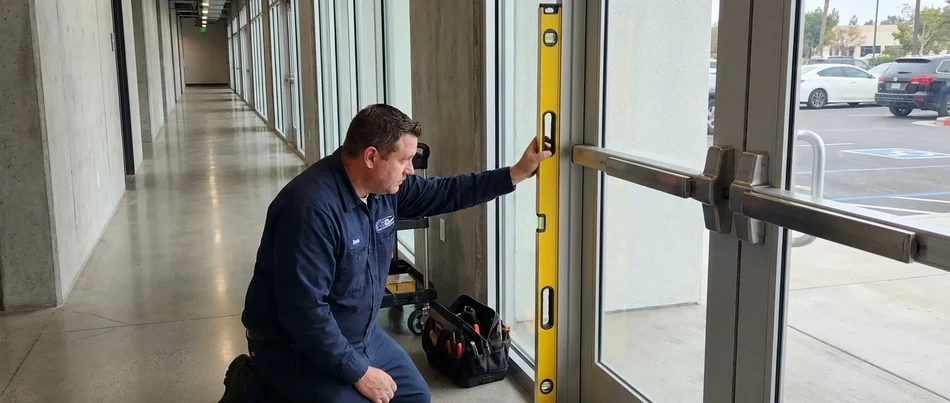
A panic bar is only as good as the door it is mounted on. We check hinges, frame alignment, closer function, and threshold condition on every job. If the door has problems, we fix them so the panic bar works correctly long-term.
What Our Customers Say
Here is what a few Ventura County customers said after we handled their panic bars and exit devices.
"Tim replaced a fire-rated Von Duprin panic bar on our restaurant kitchen exit. He checked the fire rating label, matched the door prep, and had it installed in about an hour. Also adjusted the door closer so it latches properly every time. The fire marshal approved it on the next inspection with no issues."

"We had three panic bars on a strip mall that were all sticking and hard to push. Tim came out and repaired two of them (spring replacements) and replaced the third one that was corroded beyond repair. He also flagged a dogging issue on one of the fire-rated doors that we did not know about. Fair pricing and he knew exactly what he was looking at."

"The panic bars on our warehouse loading dock doors were destroyed by salt air corrosion. Tim replaced all three with stainless steel latch bolts and recommended a maintenance schedule to prevent the same thing from happening again. He also replaced the corroded strike plates and mounting screws. Night and day difference."
 Serving All of Ventura County
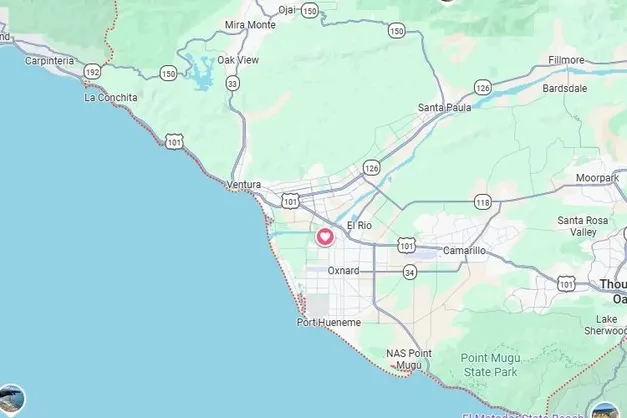
We bring panic bars and exit devices to every city we cover in Ventura County, from Oxnard to Westlake Village.
Frequently Asked Questions
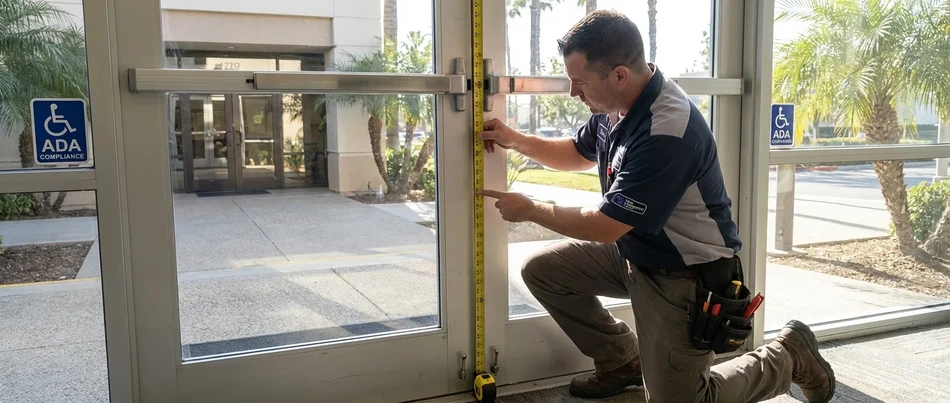
Related Commercial Services
If you need more than panic bars and exit devices, we also handle access control systems, master key systems, and commercial-grade lock installation across Ventura County.
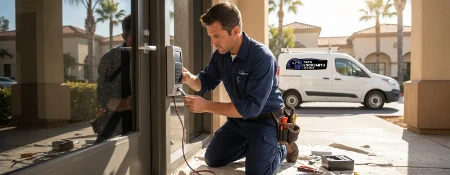
Access Control Systems
Electronic access control for businesses that need to manage who gets in and when. Card readers, keypads, fob systems, and cloud-managed access. We install, configure, and train your team on the system.
View Service
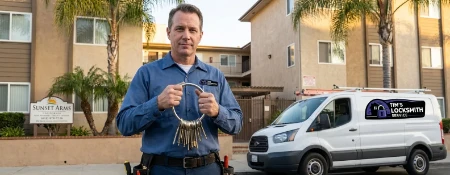
Master Key Systems
One key that opens every door, individual keys that only open assigned doors. We design and install master key systems for offices, apartment buildings, and commercial properties of any size.
View Service
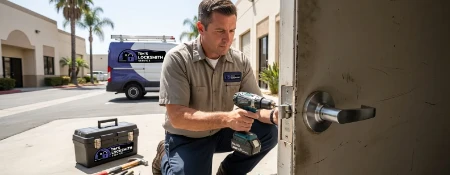
Commercial-Grade Lock Installation
Heavy-duty locks built for commercial use. We install Grade 1 and Grade 2 commercial locksets, mortise locks, and cylindrical locks for offices, retail, warehouses, and industrial doors.
View Service
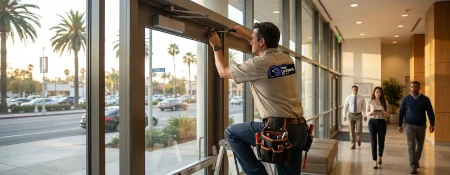
Door Closers
Commercial door closers installed, adjusted, and replaced. We work with LCN, Dorma, Norton, and other brands. Proper adjustment means the door closes at the right speed without slamming.
View Service
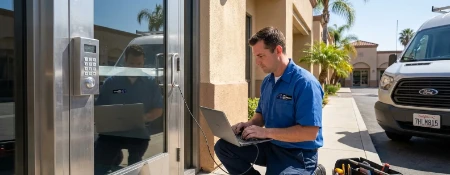
Keyless Entry Systems
Keypad locks, smart locks, and electronic entry systems for businesses. No keys to manage, no rekeying when employees leave. We install and program the system on-site.
View Service
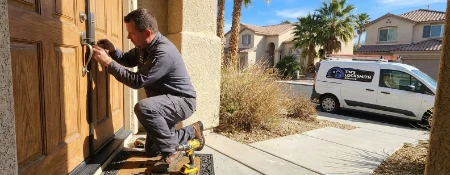
High-Security Locks
Medeco, Mul-T-Lock, Abloy, and other restricted-keyway locks for businesses that need key control. Keys cannot be duplicated without authorization. We install and service all high-security platforms.
View Service

File Cabinet and Desk Locks
Locked out of a file cabinet or desk? Lost the key? We open, rekey, and replace locks on filing cabinets, desks, and office furniture. Most jobs done in minutes.
View Service
Explore Our Other Services
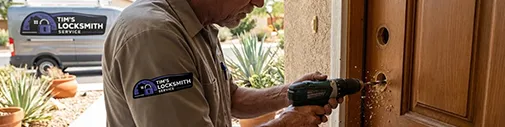
Residential Locksmith
Complete home locksmith services including lock installation, repair, rekeying, and smart lock setup, done at your door.
View Residential Services
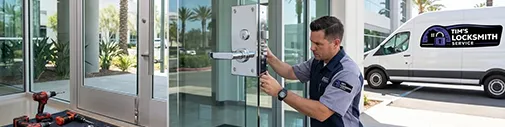
Commercial Locksmith
Business locksmith services including access control, master key systems, high-security locks, and panic hardware.
View Commercial Services
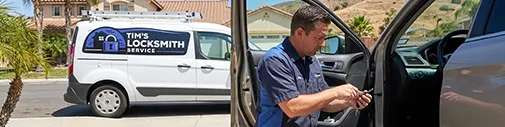
Automotive Locksmith
Car key cutting, programming, fob replacement, and ignition repair for most makes and models. We come to your vehicle.
View Automotive Services
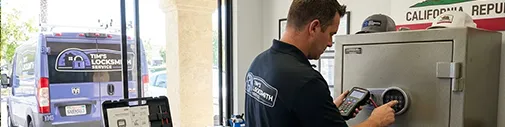
Safe Locksmith
Safe opening, combination changes, lock repair, and electronic safe programming for home and office safes. On-site service.
View Safe Services
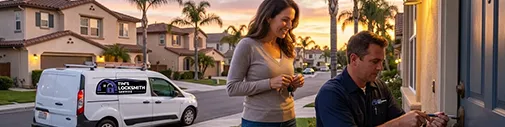
Emergency Locksmith
Fast response for home, car, and business lockouts, break-in repairs, and urgent lock needs. We come to you, usually same day.
View Emergency Services
Need Panic Bars and Exit Devices Help?
Need panic bars installed, repaired, or inspected? Call now for a free assessment and upfront quote. We come to you anywhere in Ventura County.
 Open Daily
 Mobile service across Ventura County